
Product 01 · Explore
Know what to build before you commit build spend.
A guided interview turns a fuzzy mission into a clear brief, then as many whole-system concepts as you want. Each one is checked against your brief, covers the whole system, and cannot move forward until an engineer who is not you signs it off.
The problem
Teams commit prototype, hardware and build spend before the problem is clear. The Brief sits in one person's head, concepts are debated in meetings, and engineering checks feasibility too late to change anything cheaply.
- Weeks of workshops and back-and-forth before anyone agrees what you are actually building.
- A single idea chased on a hunch, with no real alternatives put side by side.
- Concepts that look great until an engineer finally says they cannot be built.
- Safety and standards claims nobody can trace back to a source.
Explore turns a rough mission into a clear Brief and several whole-system concepts. Each concept shows how every machine in the system works together.
A guided interview draws out the real problem, the constraints, the environment and what success looks like. Then it generates distinct directions you can compare side by side, with the safety and standards claims cited to real sources.
One click brings your engineer in, free, and the concepts you picked are already waiting in their queue. Nothing locks until they approve it. Not you, them: Mitoma will not let you sign your own homework, so what you carry into Blueprint is agreed and feasible, not a hopeful sketch.
You propose. Your engineer reviews.
What's inside
Inside Explore.
Guided problem interview
A structured interview turns a rough mission into a clear, written brief: the problem, the constraints, the environment, and what success looks like. No blank page, no missed questions.
Whole-system concepts
Each concept covers the entire system, every product and machine in it, working together. You see how the pieces fit before you commit to any of them.
As many concepts as you want
Generate low-risk, balanced and ambitious directions, and keep going. Compare them side by side and pick the one that fits, instead of betting on the first idea.
Trade-off comparison
Every concept comes with a pitch, a concept of operations, and a comparison across the measures that matter, so the choice is evidence-based, not a gut call.
Physics-checked from the first conversation
The interview asks for the numbers the physics actually needs, then every concept is evaluated against Mitoma Systems' governed library of engineering physics, on one shared basis. A concept that cannot physically work says so, with the number and the source, before your engineer even opens it. And the physics advises, it does not rule: your engineer can overrule any finding, and the call is recorded with their reasoning.
Cited safety and standards claims
Where a concept leans on a safety threshold or a standard, it cites a real source your engineer can open and check. If it cannot source a claim, it says so on the concept in plain words and the concept will not lock until you cite it, reword it, or record it as an unverified assumption. No quiet confidence.
Independent engineering sign-off
A concept locks only when an engineer who is not you approves it, on the version in front of them. Edit the concept after they approve and the approval goes stale, because it was an approval of something else. Have no engineer yet? Invite one. Their seat is free.
Whole-system coverage, enforced
You confirm what the system actually is, every machine, the dock, the base station, the operator screen, before a single concept is drawn. A concept that quietly drops one of them tells you which one, and cannot lock until it covers them all.
Why it matters
What you gain.
Know what to build before you spend
Replace weeks of workshops with an afternoon of structured exploration, so you commit budget to a direction you have actually pressure-tested.
De-risk the concept early
The engineering reality check happens up front, not after months of work, and it is a wall rather than a warning: you cannot build a spec on a concept no engineer ever approved.
Feasibility is computed, not felt
Concepts arrive already checked against real, cited engineering physics, so the debate starts at "which direction is best" instead of "would this even fly".
Align the room
Everyone argues over the same written brief and the same compared concepts, so the problem you agree on is the one that moves forward.
Start small
One paid seat can start a mission. Invited Lead Engineers and specialists collaborate for free.
Invited collaborators, like your Lead Engineer and specialists, are free.
Proof in the product
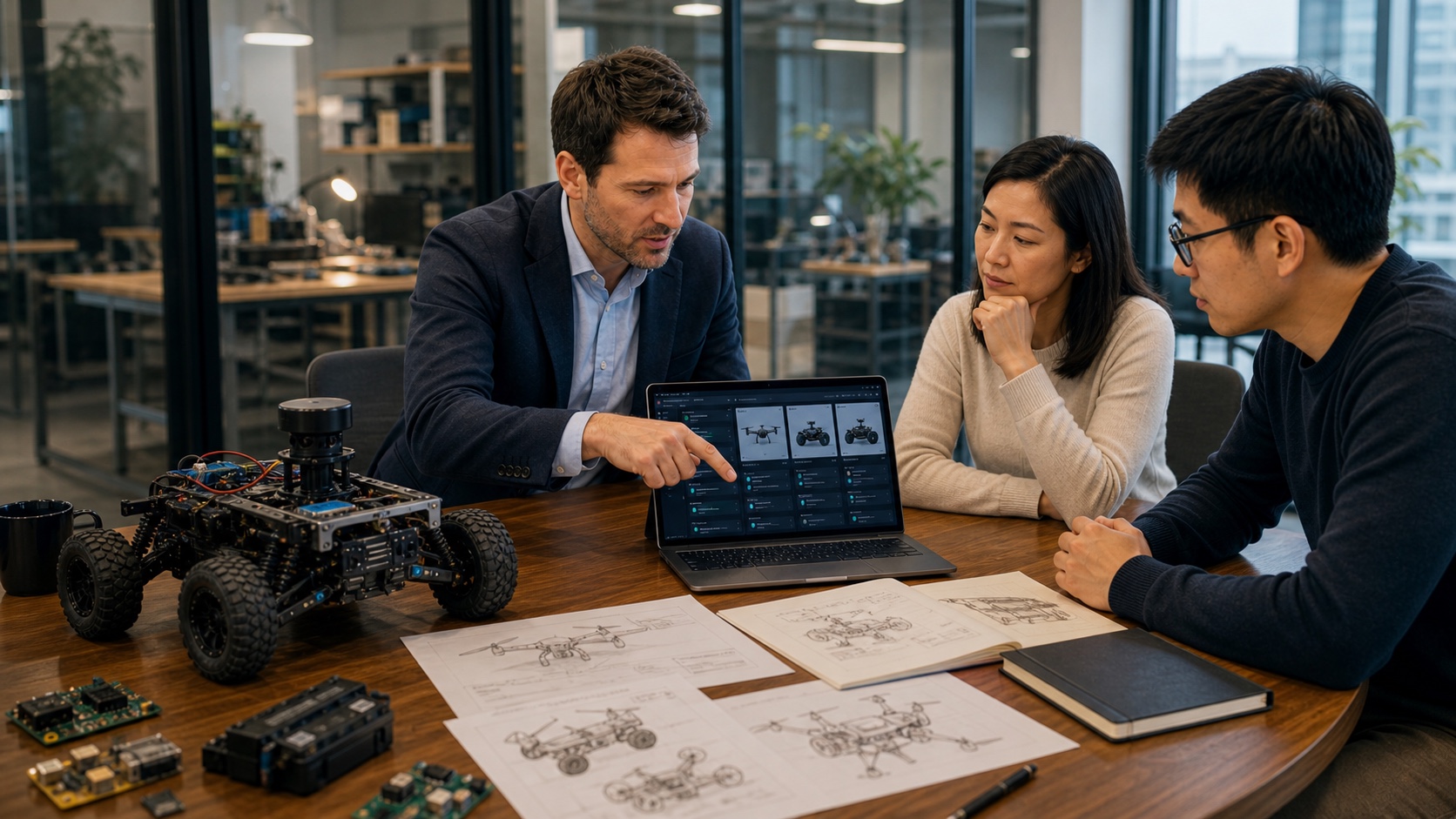
From a fuzzy idea to a costed, reviewed concept.
Explore is the fast, visual moment where a mission becomes something an engineer can react to, in an afternoon rather than a month of workshops.